Oticon, Phonak and Starkey: Compare the Technology That Matters to You
Puretone Hearing Clinic editorial team
 Clinically reviewed by Syed M. Ullah, Registered Audiologist.
If you hear well at home but miss parts of a group conversation, use that same situation to compare Oticon, Phonak and Starkey. Sound is only one part of the decision. Try the fit with your glasses on, use each charger and test your own phone with the hearing aids you would actually wear.
Three brands, three approaches to noise
Oticon, Phonak and Starkey are three of the world’s leading hearing aid makers, and their newest models handle busy places in different ways:
- Oticon: Reveal uses two AI systems at once. One brings out speech, and the other keeps useful background sounds so the room still feels natural. Oticon also makes very discreet options such as Zeal and Own SI. Read how Oticon Reveal works.
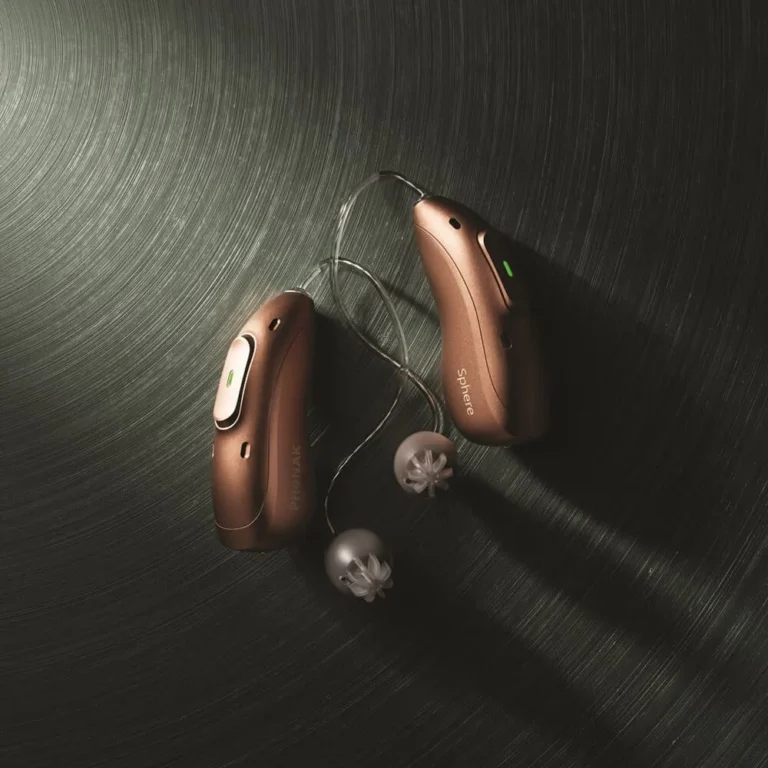
- Phonak: Sphere hearing aids have a separate AI chip dedicated to separating voices from noise. Phonak also makes power hearing aids for severe hearing loss and Roger microphones for distance listening. Read about Phonak Audéo EON Sphere.
- Starkey: Omega AI+ uses AI to manage direction and how quickly the hearing aids react to changes in loudness, and it can run its Edge Mode automatically. Starkey is also known for long battery life and health features in its app. Read about Starkey Omega AI+.
Each approach focuses on a different part of listening in noise. None of the manufacturers’ descriptions, on its own, shows that one brand will work best for everyone.
Which differences matter for you?
- If you love music or go to concerts, natural sound quality may matter more than an automatic speech-in-noise mode.
- If your hearing loss is more severe, the right receiver or power model and a secure earmould come first.
- If you use your phone for work, how the hearing aids connect to your phone may matter more than a difference in sound processing.
- If small parts are hard to handle, the charger, controls and size of the hearing aid can decide the choice.
These are reasons to pick the right model and settings for you, not reasons to think one whole brand is better or worse.
Reading manufacturer research with care
Every manufacturer publishes research, but each study uses its own speech recordings, noise levels, comparison hearing aids and test set-ups. A percentage from one company’s study can’t fairly be ranked against a percentage from another’s. Some results measure laboratory performance, and others measure comfort or preference. Neither is the same as proof that you’ll follow more of your own dinner-table conversation. The research is useful for spotting promising features, as long as we remember its limits.
Why independent advice matters
Because we’re independent, we can compare suitable options from all three manufacturers against the same hearing test. If a hearing aid doesn’t suit your hearing or the shape of your ear, a newer feature won’t fix that. Once we’ve narrowed it down to suitable choices, your daily needs, comfort and how well you actually hear guide the decision.
When you compare, the hearing aids should be set to the same level for your hearing. One that sounds louder can seem clearer even when the new feature isn’t the reason. We check this with Real-Ear Measurement, which gives a far better basis for a recommendation than the longest list of features.
Start with our hearing aid brands overview or the current model families. Ask to discuss the hearing aids that fit your assessment and routine.
Sources Oticon Canada – Reveal, Phonak Canada – EON Sphere, StarkeyPro Canada – Omega AI+ and ASHA – adult fitting and verification.